|
|
|
||
Rubén Blades
Biography
|
|||
| by Alison Weinstock |
|||
 Rubén
Blades: Rubén
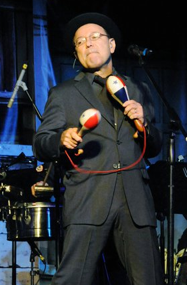
Blades: Singer, Songwriter, Actor, Lawyer, and Political Figure Rubén Blades was born in a rooming house in a small Latin American country, but he refused to see limitations or barriers; his work has crossed geopolitical borders, cultures, and genres, and has made an impact throughout the world. As a musician he has won 22 Grammys and Latin Grammys, including one in the World Music category and one in the Latin Grammy Cantautor category, and the 2017 and 2021 Latin Grammys for Album of the Year. In 2021 he was also named Latin Grammy Person of the Year. As an actor he has won a Cable ACE Award and received three Emmy, Independent Spirit, and ALMA nominations. ASCAP honored him with its Founders Award, and the Grammy Recording Academy with its Heroes Award. The Hispanic Heritage Foundation honored him with its arts award, and the Hispanic Organization of Latin Actors honored him with its Raúl Juliá HOLA Founders Award. Blades has made landmark albums in classic Afro-Cuban salsa as well as Afro-Cuban music touched with rock, jazz, pan-Latin, and other influences from around the world. He has collaborated with rock, jazz, pop, hip-hop, reggaeton, and salsa artists. He has composed hundreds of songs and dozens of hits known for their eloquent, politically-aware lyrics, colorful characters, and memorable melodies. Beyond his artistic success, Blades has always had an eye for political activism. In 1994 he formed a political party, Movimiento Papa Egoró (“Mother Earth” in the indigenous Embera language), and ran for president of his native Panama. He holds degrees in political science and law from the University of Panama and an LLM degree from Harvard Graduate Law School. He was named U.N. World Ambassador Against Racism in 2000. In 2006 the president of Chile awarded him the Pablo Neruda Order of Cultural Merit, and in 2010 the president of Ecuador honored him with their Orden Nacional al Mérito Cultural. He has received Honorary Doctorate degrees from Berkeley University in California (Chicano Studies), Lehman College in the Bronx (Humanities) and the Berklee College of Music in Boston (Music). The Loeb Music Library at Harvard University formed The Rubén Blades Archives in 2009 with the purpose of collecting his work and papers. In 2022 He was awarded the Harvard Arts Medal. He is married to Broadway actress/singer Luba Mason and currently lives in NYC. On 12/31/14 he publicly acknowledged (Spanish, English) that he has a son born in 1975. He believes that your actions should match your words, and that public service is a duty. "Si piensas y haces lo que sientes,
eres feliz".
|
 |
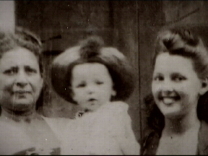 |
| Emma, Rubén, Anoland 1949 |
|
|
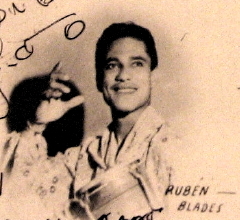
| Rubén Blades padre (complete photo) |
His grandmother Emma Blades Bosques was also a powerful influence. She was a spiritualist, a Rosicrucian, a vegetarian, a painter, a poet, and a feminist. She taught him to read and exposed him to many ideas.
His English-speaking grandfather Reuben Blades was born in St. Lucia, and came to work in Panama as an accountant during the building of the Panama Canal. On the Cuban side, Rubén descends from writers and revolutionaries who fought for independence from Spain.
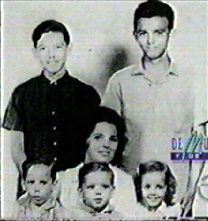 In Panama, Blades grew up on U.S. culture and rock & roll. At age 9, he saw Frankie Lymon & the Teenagers in the film Rock, Rock, Rock and tried to write a letter asking to join the group. His mother didn’t mail the letter, but she did buy him a plastic guitar. Then in 1964, civilians were killed and wounded by U.S. soldiers and Canal Zone police during riots that erupted when students tried to fly the flag of Panama next to that of the U.S. at Balboa High School. This event was traumatic for the nation and deeply affected the fifteen-year-old Blades. "They turned friends into
enemies. Even today [1984], that's the pity of
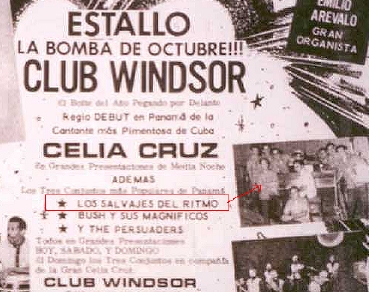
U.S. policy in Latin America." As a student at the University of Panama he composed, sang, and recorded with various groups. including Los Salvajes del Ritmo and Bush y sus Magnificos. When the university closed due to riots in 1968, he traveled to New York City and contacted Pancho Cristal, Cheo Feliciano's producer. Cristal had heard Blades sing in Panama and put him together with “Boogaloo” Pete Rodríguez to make an album. From Panama to New York was released in 1970 but didn't attract much attention. Blades says that due to the Che Guevera-inspired song "Juan González", it was banned in 17 countries. |
||||||||||||
|
Blades returned to his country to finish his law degree. Immediately after graduating he joined his family in Miami in 1974, who had been pressured to leave Panama for political reasons. He then traveled again to New York and took the only job available at Fania Records: in the mailroom. "They wouldn't record me. I had to push a
cart full of mail from 57th and Broadway to
52nd Street every day."
He seized the opportunities this contact gave him with the New York Latin music scene. Performers such as Richie Ray and Bobby Cruz, Nestor Sanchez, Bobby Rodríguez, Tito Puente, Roberto Roena, Pete "El Conde" Rodríguez, and Ismael Miranda recorded his compositions. |
||||||||||||
|
This successful collaboration led to Blades joining forces with Willie Colón, replaceing Héctor Lavoe as singer, and bringing his own ideas and compositions with him. The Colón/Blades partnership would mark an important shift in salsa music. "Ray was more interested in Afro-Cuban music and jazz. Willie was more interested with things that had to do with Latin America, and he allowed me to record my songs. It was a wonderful group of people, which I had the privilege to meet and work with." |
||||||||||||
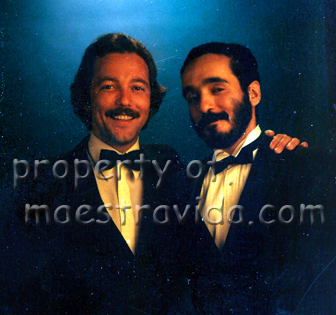  Their album Siembra (1978) was an international smash hit, with songs and arrangements that spoke to both the head and the feet, and uplifting and compelling social messages and colorful stories. The song "Pedro Navaja" broke records and remains a beloved classic. "All of a sudden you had a record
that was confronting issues and that was
unheard of at the time."
This ground-breaking album was followed by another, the two part Maestra Vida (1980), a musical drama using characters to explore social issues in a very personal way. Blades blended theatrical, literary, and political concepts with the music of the streets to tell his story of a family in the barrio. The work has been produced onstage in Panama and elsewhere in Latin America. |
||||||||||||
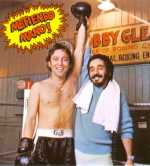
 In 1982, Blades was given the opportunity to pursue his interest in acting. Fania owner Jerry Massucci offered him a role in a low budget movie entitled The Last Fight, directed by Fred Williamson. "I
played a boxer who also sang, so we could
sell a few records."
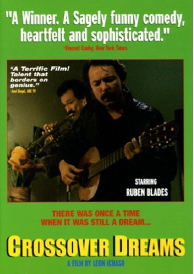
Although the film was not successful, it gave Blades his first experience in the film medium. The highly acclaimed independent film Crossover Dreams directed by Leon Ichaso followed in 1985, and his acting career was launched. He played a salsa musician trying to introduce himself into the American market, and he also co-wrote the screenplay. It was critically acclaimed and went into general release as a successful independent film. "I
can't say enough for the people of East
Harlem. They brought us soup and let us film
in their homes in exchange for our painting
them. Everybody in the community cooperated.
It was a Latin effort done by ourselves to
help ourselves."
|
||||||||||||
At the same time, Blades had
decided to form his own band and develop his
own musical ideas. Discontented with Fania’s
business practices, he signed with Elektra
Records. He formed the Joe Cuba-inspired
sextet Seis del Solar, eliminating the
traditional salsa brass section and
experimenting with rock and jazz elements.
When he recorded Buscando America
(1984), rock and jazz journalists around the
world took notice and began to write about him
and his music.
|
||||||||||||
After this success, he took a break to attend Harvard University School of Law, with the long-term goal of returning to Panama with the credentials to be taken seriously in politics. He earned a Master's Degree in International Law in 1985. "I needed something to humble myself, and
believe me, that school, which was no picnic,
did it."
The documentary The Return of Ruben Blades captures his graduation, and his return to performing. Escenas
(1985) brought him his first Grammy. His next
experiment was Agua de Luna
(1987), inspired by short stories of Colombian
magical realist author Gabriel García Márquez,
exploring literary concepts in songs. Working
with rock pioneers Lou Reed, Elvis Costello,
and Sting, he recorded Nothing But the Truth (1988)
where he joined his multi-cultural rhythms and
political themes together with English lyrics.
"I want people to acknowledge the possibilities of a Latin artist fully - meaning we can do English, too." The same year, he expressed devotion to his roots as Seis del Solar evolved into Son del Solar, bringing back the brass section for Antecedente (1988), which won him his second Grammy. |
||||||||||||
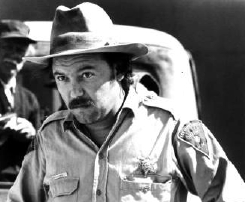 1988 also saw his first important Hollywood film role, in The Milagro Beanfield War directed by Robert Redford.  It was
followed by a leading role in Dead Man Out
(1989), where his portrayal of a killer on death
row earned him the Cable ACE Best Actor
Award. [see trailer] It was
followed by a leading role in Dead Man Out
(1989), where his portrayal of a killer on death
row earned him the Cable ACE Best Actor
Award. [see trailer]Other acting credits include: Crazy From the Heart, The Josephine Baker Story (1991), and The Maldonado Miracle (2003) all three earning him Emmy nominations; the Broadway musical The Capeman by Paul Simon (1998); and the TV series Gideon's Crossing (2000) and Fear the Walking Dead (2015-2023). [See imdb] It
was during The
Capeman that he met his current wife
Luba Mason.
|
||||||||||||
|
"I started acting by choice, however,
when I get involved in something, I try to learn
everything there is, and what I learned in
Hollywood and television in this country is that
you can't sit around and wait for the
opportunities to come by." |
||||||||||||
|
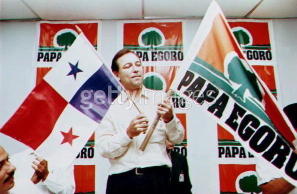
True to his social activism,
Rubén Blades returned to Panama to run for
president in 1994, as the founder and head of
the Papa Egoró Movement. He ran a grassroots
campaign of ethics and equality between
cultural and social groups across all economic
classes. He came in third of seven candidates. "In order to sustain the
integrity of the work, I felt I had to go out
there on the streets and try to make political
change possible through the political process,
not just singing. We proved it could work. We
came in third out of 24 parties, with 18% of
the vote. I'm a better, less selfish person
for it." |
||||||||||||
|
This eclectic album won a
Grammy for Best World Music and a Latin Grammy
for Best Contemporary Tropical Album. Guest
artists included bagpiper Eric
Rigler, Brazilian vocal group Boca
Livre, and Broadway singer and actress Luba Mason.
"Racism is absurd and my new
record reflects that." |
||||||||||||
He was honored by the New York
Chapter of the National Academy of Recording
Arts and Sciences with its Heroes Award in
2004, and ASCAP honored him with its Founders
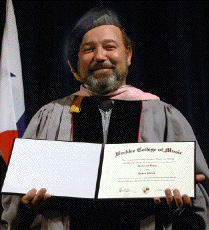
Award in 2005. Berklee
College of Music conferred on him an honorary
doctorate
in music in 2005. Princeton
University did the same in 2024.
In 2004 Blades went home to Panama for a five year term as Minister of Tourism, serving his country as he had long hoped to do.
"When I go back
to Panama, I'm going to be very happy to be
there because I really believe in my country
and I know we're going to do good things
there. It's not just a romantic dream; we
can make things happen there."
|
||||||||||||
|
||||||||||||
|
||||||||||||
 As guest artist on the
  Living in
Casco Viejo, a few blocks from Plaza
Herrera in the San Felipe neighborhood
where he was born and raised, he maintained contact with his
fans through
Living in
Casco Viejo, a few blocks from Plaza
Herrera in the San Felipe neighborhood
where he was born and raised, he maintained contact with his
fans through 

 May 16,
2013: Final judgement against
Morgalo
May 16,
2013: Final judgement against
Morgalo